


Choosing the right supplement OEM manufacturer in Malaysia is one of the most important decisions when building a health supplement brand. Beyond manufacturing costs, brand owners should evaluate formulation capabilities, quality assurance systems, regulatory support, production flexibility and long-term manufacturing reliability.
An experienced OEM partner should do more than manufacture your products. They should help you navigate product development challenges, manage quality expectations and support your brand’s growth.
At Harvest Group, we believe OEM manufacturing should be treated as a complete product development process rather than simply a transaction between a brand and a factory.
Our approach covers product development, quality assurance and control, laboratory testing, packaging, regulatory support, production and logistics as part of an integrated OEM process. You can learn more about our supplement OEM manufacturing services and how we support brands from concept to finished product.
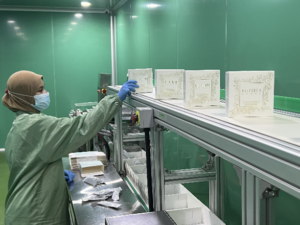
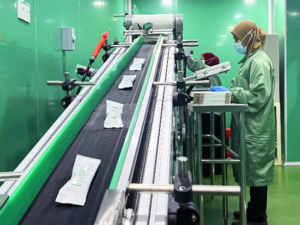
Don’t Choose a Supplement OEM Manufacturer Based on Price Alone
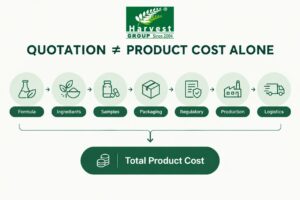
Price is important. Every business has a budget, and an OEM manufacturer needs to provide a commercially viable quotation.
However, comparing manufacturers based only on the final price can create problems later.
Two manufacturers may quote very different prices for products that appear to be similar on paper. The difference may come from:
- Ingredient quality and specifications (patent ingredients may cost higher)
- Active ingredient dosage
- Raw material sourcing
- Formulation complexity
- Laboratory testing
- Stability requirements
- Packaging specifications
- Production processes
- Regulatory support
- Quality control procedures
- Minimum order quantities
- Packaging or logistics requirements
This is why a quotation should always be evaluated together with what is actually included in the product development and manufacturing process.
Understand What Is Behind the Quotation
Imagine two manufacturers quote for a similar-looking supplement.
Manufacturer A provides a lower price.
Manufacturer B provides a higher price.
At first glance, Manufacturer A appears to offer the better deal.
But after looking at the formulation, you discover that the two products use different ingredient specifications, different dosages and different testing requirements.
The products may look similar when they reach the shelf, but they are not necessarily equivalent products.
This is particularly important for brands that want to build a long-term position in the market rather than simply launch the lowest-cost product available.
A better question is not:
“Who can manufacture this product for the lowest price?”
It is:
“What am I actually getting for the price I am paying?”
Look for Proven Formulation, Not Just Lower Costing Price

A supplement manufacturer should not simply ask you what product you want and then produce it.
The development stage is where many important decisions are made.
Your OEM partner should be able to understand:
- Your target consumer
- Product positioning
- Desired dosage form
- Ingredient selection
- Formula objectives
- Flavour and sensory considerations
- Target cost
- Manufacturing feasibility
- Regulatory considerations
- Packaging requirements
- Expected market positioning
At Harvest Group, research and product development are part of our OEM process. Our R&D team works with customers to understand their ideas and customise products around their requirements rather than treating every project as a standard catalogue item.
Your Formula Should Match Your Product Positioning
A formula is not developed in isolation.
For example, a brand positioned as a premium beauty supplement may require a very different formulation strategy from a general mass-market daily nutritional product.
The ingredients, dosage, format, packaging, serving size and overall cost structure all need to work together.
This is why formulation should be considered alongside commercial positioning from the beginning.
A technically interesting formula that cannot achieve its target cost, taste, format or production requirements may not be commercially practical.
The goal is not simply to create a formula.
The goal is to create a product that makes sense for the brand.
Transparency Should Be Part of the OEM Relationship
A professional OEM relationship should not feel like a black box.
You should be able to understand what is being developed, what is being tested and what is being manufactured.
This does not mean a manufacturer needs to reveal proprietary information or confidential supplier arrangements.
It means the development process should be sufficiently transparent for the brand owner to make informed decisions.
Ask Questions About the Manufacturing Process
Before choosing a manufacturer, ask questions such as:
- Where are the ingredients sourced from?
- What ingredient specifications are being used?
- What testing is performed?
- How is raw material quality controlled?
- What quality checks are performed during production?
- What laboratory testing is available?
- What documentation can be provided?
- What regulatory support is available?
- What happens if a batch does not meet specifications?
- How are finished products released?
- What support is available after production?
Harvest’s contract manufacturing process includes quality assurance and quality control, laboratory testing, regulatory applications, production and warehouse logistics. Laboratory testing can include physical testing, heavy metal testing, stability testing and nutritional testing depending on the product requirements.
That type of process matters because product quality should not depend solely on what happens during the final manufacturing stage.
Check the Manufacturer’s Certifications and Quality Standards
Certifications should not be treated as decorative logos on a website.
They should be part of your evaluation of how a manufacturer manages quality, food safety and production.
For health supplement manufacturing in Malaysia, GMP is particularly important. The National Pharmaceutical Regulatory Agency (NPRA) publishes specific guidelines for Good Manufacturing Practice for Traditional Medicines and Health Supplements, and its guidance states that GMP compliance is a condition considered in the evaluation of applications for a manufacturing license.
NPRA also provides guidance relating to health supplement registration and regulatory requirements, making regulatory readiness an important part of selecting an OEM partner in Malaysia.
Look Beyond the Certification List
You should not simply ask:
“Is your factory GMP certified?”
Ask what the manufacturer’s quality system actually looks like.
A meaningful assessment can include:
- Quality assurance procedures
- Quality control processes
- Raw material controls
- Laboratory testing
- Production controls
- Batch documentation
- Finished product testing
- Traceability
- Regulatory documentation
- Handling of non-conforming products
Harvest Group’s manufacturing and quality systems incorporate standards and certifications including GMP, HACCP, ISO 9001 and ISO 22000, alongside Halal certification.
For food safety management, ISO 22000 provides requirements for a food safety management system for organizations within the food chain. The current published ISO 22000:2018 edition remains current according to ISO’s official standard page.
HACCP is also more than a logo. The Codex General Principles of Food Hygiene describe HACCP as an approach focused on identifying and controlling significant food-safety hazards through critical control points, monitoring and corrective actions.
These standards provide useful reference points when evaluating how seriously an OEM manufacturer approaches quality and food safety.
Genuine Ingredients Matter
The formula on paper is only as good as the ingredients and specifications behind it.
This is one area where brands should ask more detailed questions instead of accepting broad descriptions such as “premium ingredients” or “high-quality raw materials.”
Ask what the ingredient actually is.
Ask about:
- Ingredient identity
- Standardization
- Active compound or nutrient content
- Source
- Specification
- Testing
- Documentation
- Country of origin where relevant
- Storage requirements
- Stability considerations
Don’t Compare Ingredients by Name Alone
Two products can contain the same ingredient name but still differ significantly in specification, concentration, source, processing method or dosage.
For example, comparing “collagen,” “probiotics,” “plant extract” or another functional ingredient based only on the ingredient name may not tell you enough about the finished formulation.
A professional formulation discussion should therefore look beyond the ingredient label and consider the actual specification and intended use.
This is where an experienced R&D team can add value.
At Harvest Group, our approach combines formulation development with ingredient selection and scientific support to develop products according to the brand’s intended positioning and requirements.
Professional Consultation Is a Major Advantage

One of the most valuable parts of working with an experienced OEM manufacturer is the consultation process.
You may come to a manufacturer with a product idea.
But your initial idea may not always be the most practical version of the product.
An experienced OEM team should be able to discuss:
- Whether the concept is technically feasible
- Whether the proposed ingredients make sense together
- Whether the dosage is practical
- Whether the product format is suitable
- Whether the target cost is realistic
- Whether the product can be manufactured efficiently
- Whether the proposed claims require additional regulatory consideration
- Whether the product has a clear commercial position
Harvest Group provides a one-stop solution covering planning, development, design, product registration, production, distribution and marketing support.
This integrated approach can reduce the number of disconnected suppliers and communication gaps involved in taking a product from concept to market.
A Good OEM Should Be Willing to Say No
This may sound counterintuitive.
But a manufacturer that agrees with everything you request is not necessarily the best manufacturing partner.
Sometimes the right answer should be:
“We don’t recommend doing it that way.”
Perhaps the dosage is impractical.
Perhaps the ingredients do not work well together.
Perhaps the product would become too expensive.
Perhaps the desired format creates manufacturing difficulties.
Perhaps the proposed claim needs further regulatory review.
A good OEM relationship is not about saying yes to everything.
It is about finding a practical way to achieve the underlying business objective.
Experience Should Help You Avoid Expensive Mistakes
For a new brand owner, it can be difficult to identify potential problems before production begins.
An experienced OEM partner can bring knowledge from R&D, production, QA/QC, regulatory and packaging teams into the discussion.
This is one of the reasons we believe an OEM manufacturer should be evaluated as a product development partner rather than simply as a production facility.
Think About Commercial Feasibility, Not Just Product Development
A product can be technically excellent and still fail commercially.
Before finalising a formula, consider the complete economics of the product.
This includes:
- Ingredient cost
- Serving size
- Number of servings per box
- Packaging
- Manufacturing cost
- Testing
- Logistics
- Regulatory requirements
- Distributor margins
- Retail margins
- Marketing costs
- Target selling price
A formula should therefore be developed with the commercial model in mind.
If your product costs too much to manufacture, you may be forced to price it beyond what your target market is willing to pay.
If you reduce the formula later simply to make the product cheaper, you may compromise the original positioning.
It is usually more efficient to discuss the target cost and market positioning with your OEM partner early in the development process.
What Should You Ask a Supplement OEM Manufacturer Before Choosing Them?
Before committing to an OEM manufacturer, prepare a structured list of questions.
Formulation and R&D
Ask:
- Do you provide custom formulation?
- Can the formulation be adjusted according to my target cost?
- Can you advise on dosage form and product format?
- How many rounds of formulation and samples devcelopment are included?
Ingredients
Ask:
- What ingredient specifications are available?
- How are raw materials evaluated?
- What documentation is available?
- Can you source specific ingredients?
Quality and Testing
Ask:
- What certifications does the facility hold?
- What laboratory tests are available?
- How are finished products tested?
- How are batches documented and released?
Manufacturing
Ask:
- What product form factors can you manufacture?
- What is the minimum order quantity?
- What is the typical production lead time?
- What packaging formats are available?
- How is production quality monitored?
- How is batch traceability managed?
Regulatory Support
Ask:
- Can you assist with product registration?
- Do you provide regulatory consultation?
- Can you assist with Halal application?
- Can you assist with health or nutritional claims?
- Can you support documentation for export markets?
NPRA’s published health supplement guidance and GMP documentation are useful references when discussing these requirements with a prospective Malaysian manufacturer.
The Right OEM Is a Long-Term Partner, Not Just a Factory
A successful supplement brand rarely ends with the first production run.
As the brand grows, you may need:
- New product development
- Formula improvements
- New product formats
- Additional packaging options
- Larger production volumes
- New product categories
- Regulatory assistance
- Export documentation
- Supply chain support
- Product extensions
This is why the relationship with your OEM manufacturer can become strategically important.
Harvest Group provides an integrated OEM process covering R&D, QA/QC, laboratory testing, packaging, regulatory support, production and logistics.
Our facilities and manufacturing capabilities are designed around the need for controlled and efficient product manufacturing, while our company background and OEM experience provide further context on how we approach product development and manufacturing.
For brands looking beyond Malaysia, Harvest also supports customers with export-related requirements and has experience working with international markets.
A Supplement OEM Manufacturer Should Help Connect the Entire Process
The strongest OEM relationships are built when formulation, ingredients, quality, manufacturing, regulatory and commercial considerations are discussed together.
Instead of asking:
“Can you manufacture this supplement?”
Ask:
“Can you help me develop and manufacture a product that makes sense for my brand and market?”
That shift in thinking can significantly change how you evaluate potential manufacturing partners.
A manufacturer may have impressive machinery and a competitive quotation, but if the communication, formulation support, quality systems or regulatory understanding are weak, problems can appear later.
The best OEM relationship is one where both sides understand the objective from the beginning.
Final Thoughts: Don’t Ask Only “How Cheap Can You Make It?”
Choosing a supplement OEM manufacturer is not simply a purchasing decision.
It is a product development decision, a quality decision and ultimately a business decision.
Look at the complete picture:
- Formulation and R&D expertise
- Ingredient quality and specifications
- Quality assurance and quality control
- Laboratory testing
- GMP and relevant certifications
- Regulatory knowledge
- Manufacturing capabilities
- Packaging and logistics
- Communication
- Commercial feasibility
- Long-term product development support
For Malaysian brands, official regulatory resources such as NPRA should also form part of your evaluation process rather than relying solely on an OEM manufacturer’s marketing claims.
At Harvest Group, our objective is to bridge the gap between your product idea and the finished product through an integrated OEM process.
You own the brand. We help handle the development and manufacturing behind it.
Ready to Develop Your Own Supplement Brand?
Have an idea for your own health supplement or health food product?
Talk to Harvest Group’s OEM team about your product concept, target market, formulation requirements and manufacturing needs.
Whether you are starting a new supplement brand, developing a private label product or expanding an existing product portfolio, our team can discuss the practical steps involved in taking your idea from concept to production.
Contact Harvest Group to discuss your OEM project and request an OEM consultation.
Have a Product Idea? Talk to Our Nutritionists Today.


